
When planning a new build or extension, one of the earliest and most important decisions is the type of foundation required. It’s also one of the least understood. Terms like raft foundation, pile foundations, or piled raft foundation are often introduced quickly, without much explanation, leaving many people unsure what they actually mean for their project.
At a basic level, all foundations do the same job. They safely transfer the weight of a building into the ground. The difference lies in how they do this and, more importantly, the ground conditions they’re designed to work with. Choosing the wrong foundation can lead to unnecessary cost, delays or long-term movement issues. Choosing the right one helps keep the build stable, proportionate and predictable.
There’s no default or “better” option. Some sites are well suited to raft foundations, while others require pile foundations to reach deeper, more competent ground. In some cases, a pile and raft foundation offers the most balanced solution.
This guide explains the differences, when each foundation type is used, and how the right choice is made, so you can understand why a particular solution is recommended for your site.
What Are Pile Foundations?
Pile foundations are a type of deep foundation used where the ground near the surface isn’t strong or reliable enough to support a building safely. Instead of relying on shallow soil, piles transfer the load down to deeper, more competent ground.
They’re commonly used where settlement needs to be tightly controlled or where ground conditions are poor or unpredictable.
How pile foundations work
Pile foundations work by:
- Installing long, slender columns into the ground
- Passing through weak or compressible soils
- Bearing onto stronger soil layers or rock at depth
Each pile acts as a load path, carrying weight away from unsuitable near-surface ground.
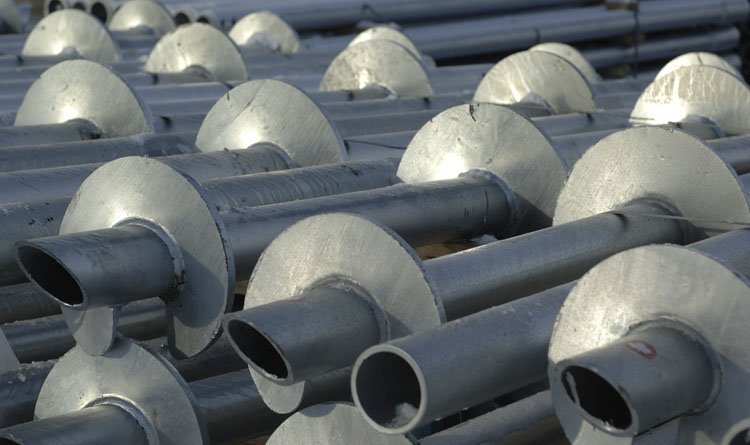
Types of piles
End Bearing Piles. The bottom end of the pile rests on a layer of rock or heavy soil in order to transfer the building load to a strong substrate layer.
Friction Piles. These transfer the building load to the surrounding soil using the entire length of the pile.
Mini Piles. In areas where there are restrictions or limitations to building, we can use mini piling. They cause minimal disruption and have lower noise levels.
Screw Piles. Also helical piles, these piles are screwed into the ground using spiral blades.
When pile foundations are used
Pile foundations are typically required where:
- Surface soils have low bearing capacity
- Ground conditions vary across the site
- Made ground or soft clay is present
- Structural loads are high
You can see how piling solutions are applied in practice on our piling contractors page.
Pile foundations are a complicated foundation type and need to be installed by skilled professionals. because of this, they can be more expensive compared to other foundation types.
Raft Foundations
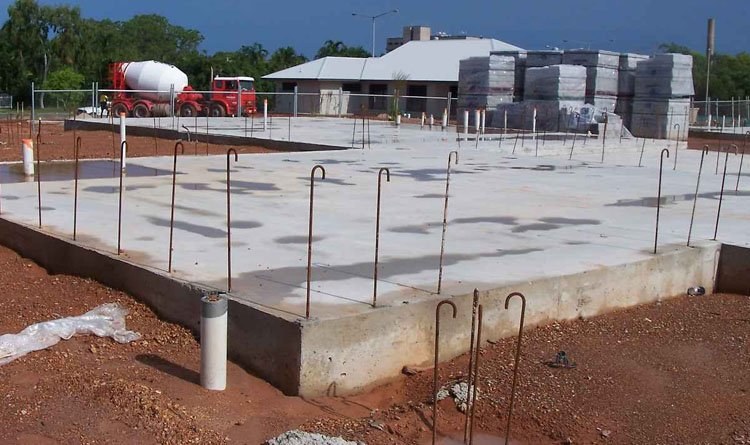
Raft Foundations, or mat foundations, are essentially a ‘mat’ of concrete that sits either on, or just under, the ground.
A raft foundation is a single, reinforced concrete slab that spreads the weight of a building across a wide area of ground. Instead of supporting loads at individual points, the raft works as one continuous base.
They typically cover the entire footprint of a building and spread the load that’s placed on top of them. Raft foundations are typically used on low-rise buildings where the ground near the surface has enough strength and consistency to support the structure safely.
What are raft foundations used for?
Raft foundations are commonly used where:
- Ground conditions are uniform across the site
- Near-surface soils have adequate bearing capacity
- Loads can be spread evenly rather than concentrated
- A shallow foundation solution is appropriate
They’re often used for houses, small residential developments and some commercial buildings.
How a raft foundation works
A raft foundation:
- Covers the full footprint of the building
- Distributes loads evenly into the ground
- Helps reduce differential settlement
Because the building sits on a single slab, minor ground movement is shared across the raft rather than causing isolated cracking.
Raft foundations are best suited to one or two-storey buildings or spaces where a basement is required, which is why they are often used for domestic properties. They are easy to construct and fairly inexpensive but can be prone to erosion at their edges. They aren’t usually used in instances where heavy reinforcement may be needed in particular areas.
Raft Foundations vs Pile Foundations: The Core Difference
The fundamental difference between raft foundations and pile foundations is how they deal with the ground beneath a building.
How raft foundations support loads
Raft foundations spread loads across a large area and rely on the strength of shallow soils to support the structure.
How pile foundations support loads
Pile foundations bypass weak soils and transfer loads to deeper, stronger strata where settlement is more predictable.
Which is better?
Neither option is automatically better. Raft foundations suit uniform, competent ground. Pile foundations are required where shallow soils can’t safely support loads.
Ground Conditions and Suitability
Ground conditions are usually the deciding factor when choosing between a raft foundation and pile foundations.
What ground conditions suit raft foundations?
Raft foundations are generally suitable where soils are uniform, stable and have adequate bearing capacity near the surface.
When pile foundations are required
Pile foundations are usually required where soils are weak, variable, compressible or affected by made ground or groundwater.
A ground investigation identifies soil layers, groundwater and bearing strata, allowing engineers to confirm which foundation solution is suitable.
Cost, Value and Proportion
Are raft foundations cheaper than piles?
On suitable ground, raft foundations are often cheaper because they require less specialist equipment and shallower construction.
When piles offer better value
Pile foundations usually cost more upfront, but they reduce long-term risk on difficult sites. That extra cost can prevent future movement, cracking or remedial work.
Choosing a proportionate solution
A proportionate foundation design balances ground conditions, structural loads, performance and cost. The cheapest option isn’t always the best value.
What Is a Piled Raft Foundation?
A piled raft foundation, also known as a pile and raft foundation, combines both systems. The building load is shared between the raft and a reduced number of piles.
When a piled raft foundation is used
Piled raft foundations are often used where:
- Ground conditions are moderate but not ideal
- A raft alone would settle too much
- Full piling would be excessive
This approach can reduce pile numbers while maintaining settlement control.
Risk, Settlement and Long-Term Performance
Settlement is the main risk foundation design aims to control.
Do raft foundations crack?
Raft foundations don’t automatically crack, but they can if used on unsuitable ground or where settlement is uneven.
How piles reduce settlement risk
Pile foundations reduce settlement by transferring loads to deeper, more stable ground with predictable behaviour.
Designing for movement
No foundation eliminates movement entirely. Good design controls settlement so it stays within safe limits.
Do house extensions need piles or rafts?
Some extensions can use raft foundations. Others require pile foundations or a piled raft foundation, depending on ground conditions and proximity to existing foundations.
Are raft foundations suitable for houses?
Raft foundations are often suitable for houses on consistent ground. On infill plots or variable sites, piling may be required.
How the Right Foundation Is Chosen
Choosing the right foundation follows a clear process:
- Ground investigation
- Structural design and load assessment
- Settlement and risk evaluation
- Practical site constraints
The final choice is evidence-led, not assumption-led.
Get in touch with a professional
The best way to figure out the type of foundations needed is to have a consultation with a qualified groundworks expert. Depending on the surrounding soil and size of the building, they can advise on whether pile or raft foundations will be more suited to your construction. Get in touch with us today to arrange a free no-obligation quote.